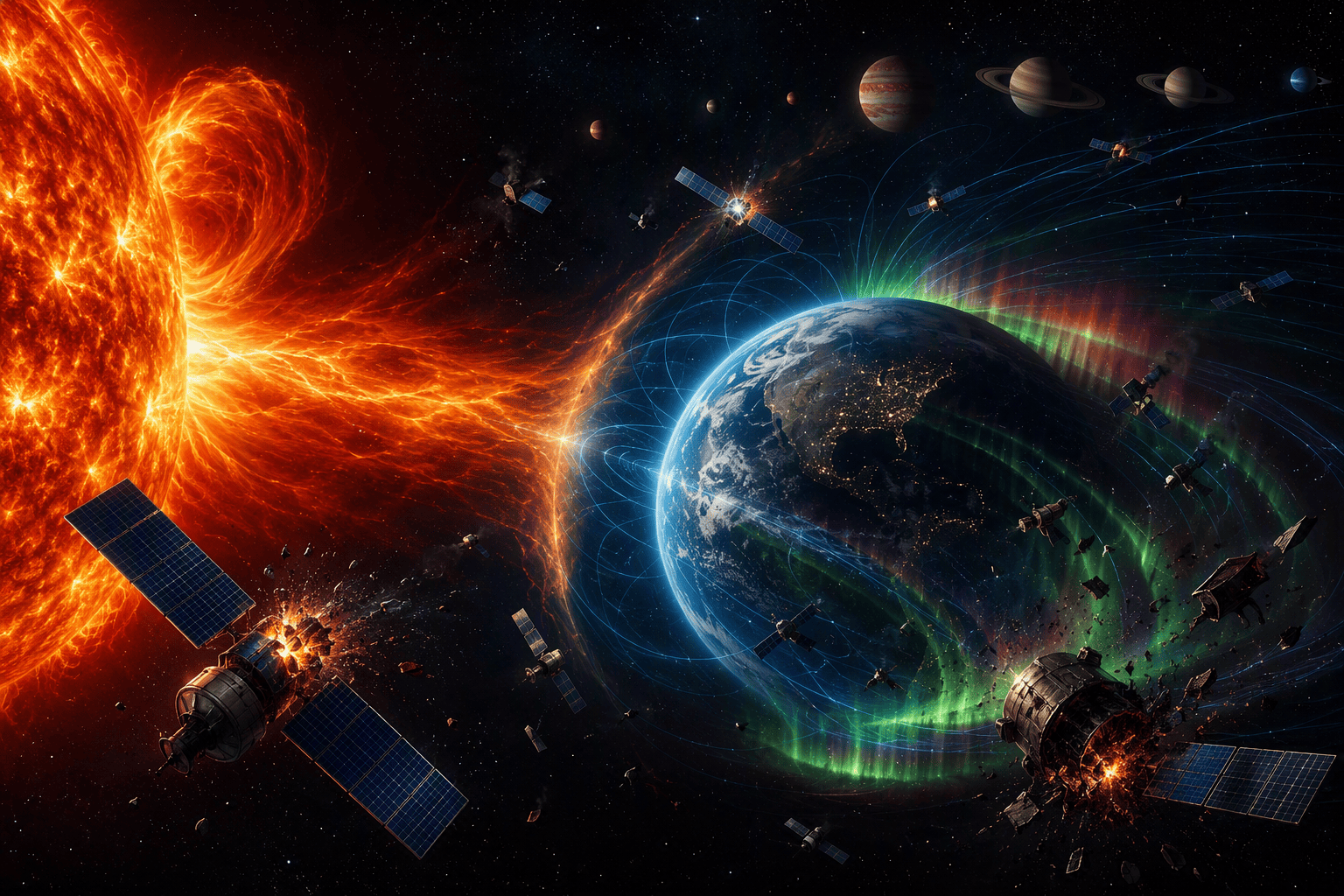
What would you do if there was widespread disruption or failure of our near-Earth infrastructure?
By that I mean the satellites that:
- Provide position and timing information for your GPS navigation – and that of the aeroplane you are flying on
- Provide global internet access for many – e.g. Starlink
- Provide communications for the military, government, aviation systems etc.
- Carry out weather and environmental monitoring
There are many more services that you just don’t consider when we talk about low Earth orbit such as finance, transport, power grids, and with that global manufacturing etc. All of these sectors depend heavily on satellites to function effectively.
Sounds scary right?
Well it’s something I’ve been thinking more and more about.
Many of you will know that the Sun has been at, or close to its so-called solar maximum over the last couple of years. This is the period in a cycle that sees solar activity, sun spots, and geomagnetic storms increase in intensity and frequency – and occurs every 11 years or so.
No one really understands for certain why – although many scientists have well developed theories on many aspects of the solar cycle.
It does bring pleasing views such as the 2024 Aurora apparitions during the summer and early autumn in places where you wouldn’t normally expect to see it – e.g. Rochdale, UK where I live. However it has other consequences, such as the dozens of SpaceX Starlink satellites that were knocked out of orbit by the Sun’s activity during a 2022 geomagnetic storm.

This wasn’t even a particularly big solar storm in the context of history.
The Carrington event is a well documented solar storm that is currently the most intense geomagnetic storm reliably recorded. It occurred in 1859, and was associated with a major solar eruption observed by Richard Carrington. It produced spectacular auroras but also resulted in widespread disruption to the telegraph system, resulting in failures and even electric shocks to some telegraph operators – and this was in a world pre-space travel, pre-satellites, pre-aviation.
This sounds bad enough, but in 2012 Fusa Miyake found some evidence that there may have been an even more extreme space weather event around AD 774-775. The evidence is based on the carbon-14 signature recorded in tree rings. Most years this is pretty consistent, but in 774-775 it spikes way higher than normal. Further research has shown that this event could have been caused by an extreme solar energetic particle event – potentially several times more intense than the Carrington event, although the exact cause is still an area of active research. These events could occur every few thousand years.
The main approach to mitigating the risks posed by these events is early detection and forecasting through dedicated space weather missions, including NOAA’s SOLAR-1 mission and ESA’s Vigil mission. These missions provide advance warning of potentially disruptive solar activity, giving satellite operators time to take protective measures. In addition, satellite operators improve resilience by incorporating radiation protection and fault tolerant systems to ‘harden’ spacecraft against such events, as well as temporarily shutting down or placing systems into ‘safe mode’ during periods of significant space weather activity.
The research is still ongoing, but the questions I have in my head now are: how prepared are satellite constellation operators for such a storm? What steps can we take to mitigate it? And how would the world react if suddenly everything you know and rely on is severely disrupted or unavailable?
Not a cheery post I know, but certainly an area that I’m interested in researching further.
Further reading
How ancient trees are warning us about the next enormous solar storm | New Scientist
 Dan Roach Flying Author