“If it’s a surprise to see Tolstoy detonate an equation in the middle of the Napoleonic battlefield, then wait until he brings the big guns out: he uses calculus as a metaphor for understanding the whole of human history.”
Intrigued?
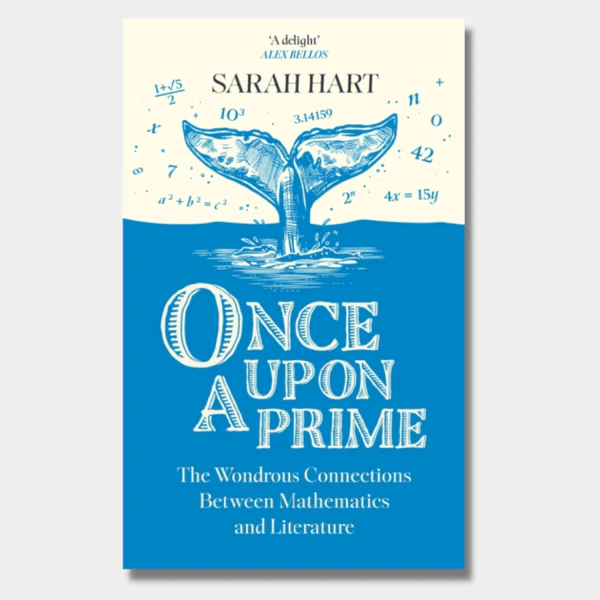
This entertaining metaphor is a great example of the colourful prose to be found in Once Upon a Prime, Sarah Hart’s first book. A Professor of Mathematics at Birkbeck College, Hart has held until recently the Gresham Professorship of Geometry.
Full disclosure: I’ve no degree in either English or Mathematics – GCSE grade ‘C’ was my highlight. I am, however, a writer and student physicist who loves maths, and I had no problem with most of the concepts explored – so this book should be accessible for almost anyone.
The book is arranged in 3 parts consisting of 4, 3 and 3 chapters respectively. There doesn’t seem to be any obvious mathematical structure to this arrangement which feels like a missed opportunity as part 1 explores structure in great detail, beginning with poetry. As a fairly, how shall I put it, “light reader of poetry” I was not familiar with some of the constructs used to illustrate the connections, but I still found it fascinating to read about the pattern of iambic pentameter and the structure of a limerick. Using mnemonics to remember the digits of pi is likely to be familiar territory for many people, but what about a poem that will give you pi to over 40 decimal places?
Further on, I enjoyed the exploration of the symbolism of numbers but one thing not considered is that perhaps smaller numbers are popular in children’s literature because we use nursery rhymes and stories to teach children to count, usually to ten, as we’ve got ten fingers…
Apart from mathematics, there is plenty of natural science in the book which delves into square-cube law and its application to theoretically miniature or gargantuan humans. This segue into biology and physics adds depth to Hart’s analysis of the author’s different uses of mathematics to validate a story point, even if at times it is not completely scientifically rooted. Hart demonstrates this by highlighting that some authors have used what we, in post COVID times, would call ‘pseudo-science’ to add weight to their story.
Finally, Hart quite rightly highlights the stereotypical portrayal of mathematicians in fiction citing, Sherlock Holmes amongst others. I’m sure many of you will agree that mathematicians come in a variety of guises, and most of them don’t smoke a pipe or wear a deer stalker!
Initially, I was a bit sceptical about some of the links proposed by Hart, as they appeared somewhat arbitrary and open to interpretation. However, as the book progresses it becomes clearer that the argument proposed – that there is a distinct link between mathematics and literature – is evidence based. Perhaps beginning with a different chapter would have been more enticing, but for those who get to chapter two, you are in for a delightful unpeeling of a booker prize winning novel. I also really enjoyed the exploration of fractals (think Jurassic Park and chaos theory) and cryptography (The Da Vinci Code). The included book cipher was great fun, and yes, I did crack it – before you ask!
Each chapter concludes with a summary, making it an easy book to pick up and read periodically, however, this also meant I was a little surprised to find no summation at the end of the final chapter. It’s a small niggle but a little inconsistent given the structure of the previous chapters, the author instead preferring to jump straight to the acknowledgments. The use of imperial units periodically is also a little distracting and I think given the nature of the subject matter, it might have been better to use SI units throughout – or at least consistently convert them. I’ve no idea what an ounce is!
I did however, like the way Hart pulled apart the 200-year-old perspective: that if you hadn’t done anything in maths by the time you were 40, you never would, pointing out that most people died before they hit 50 in those times, and therefore would have done EVERYTHING before their 40s. I also enjoyed the entertaining adjectives used to describe insect sizes – it’s clear Hart isn’t keen on invertebrates!
The author’s voice, however, is warm and compelling throughout and it feels like you are having a chat over a coffee. The book has certainly won me over and having always been fascinated by, and enjoyed mathematics (despite that ‘C’ at GCSE) it has added a new dimension (sorry) to my appreciation of literature.
And I definitely want to detonate more equations in my own work – what a phrase!
Once Upon a Prime, Hart, Sarah. (2023)
Published in London by Mudlark.
ISBN: 978-0008601089
 Dan Roach Flying Author