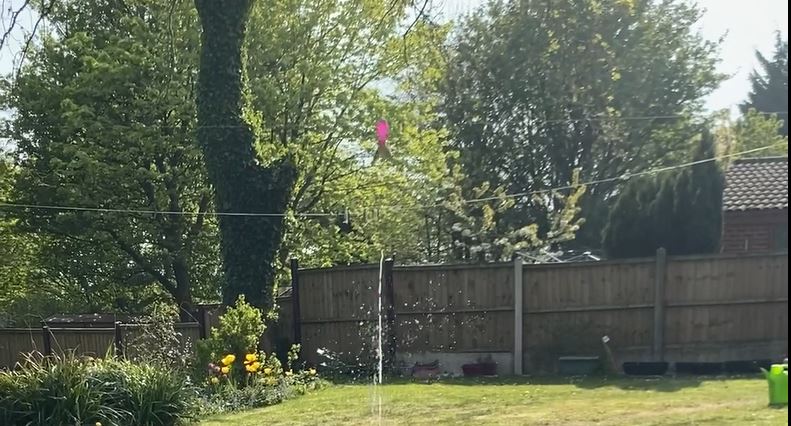
“Yaaaay!”
Delightful screams of joy from my then, 10 year old daughter, confirm that launching a rocket from our garden was indeed, a genius idea.
A few years ago during the summer of the pandemic, I was running out of things to do to entertain Elektra, the youngest of my three girls. So, I went rooting through the garage to see what outdoor activities we had hidden away amongst all the other important ‘stuff’ that we and most other folk use our garages to store, as opposed to putting our cars in them.
You know, all the stuff we don’t need, and can’t be bothered to take to the tip… Yeah, we keep that safely indoors protected from the weather while the single most expensive purchase for most people, outside of a house, sits on the drive.
Inspired!
Anyway, I came across a Science Museum Cosmic Rocket that I’d bought a couple of years previously and promptly forgotten about.
“Hmmm, Interesting”
This type of activity ticks a lot of boxes for pre-teen children:
It’s messy 
It’s noisy
It’s fun
It’s also quite different to playing Roblox or messing about on Tiktok or whatever the current must have data collection app is…

Now before you get all concerned about health & safety, NOTAMs and launching fireworks with a pre-teen, this is a rocket that is powered by reacting vinegar and baking soda together to produce salt, water and crucially carbon dioxide. As the pressure of the CO2 builds up inside the rocket it eventually seeks the easiest way out, which in this case, is through the exhaust at the base of the rocket. And once we have more force generated from the thrust than we have force holding us on the ground from gravity, we have lift off! So, no burning of rocket fuel on this occasion – although, that sounds like fun as well!
If you are interested, and go on, admit you are, here is the chemical reaction in question that produces said thrust.

The instructions were clear and easy to follow, but it did take us a few attempts to refine the chemical ratio to get the perfect launch. We had several launch “anomalies” (as rocket failures now seem to be called these days) before we perfected the mixture and got several perfect (nominal?) launches. This is a great analogue for how rockets are actually developed, such as the approach taken by SpaceX and others: fly, see what breaks, fix it and fly again.

The beauty of this type of rocket is that you can use it again and again and again. It’s really simple, uncomplicated fun that demonstrates chemistry, physics and rocketry in an interesting and exciting way for a pre-teen (plus this very much post-teen enjoyed it too!) It led to a great afternoon of fun, with moments like the one above, accompanied by whoops and hollers of delight!
I mean, be honest: who doesn’t want to launch rockets with their kids in the garden?
 Dan Roach Flying Author