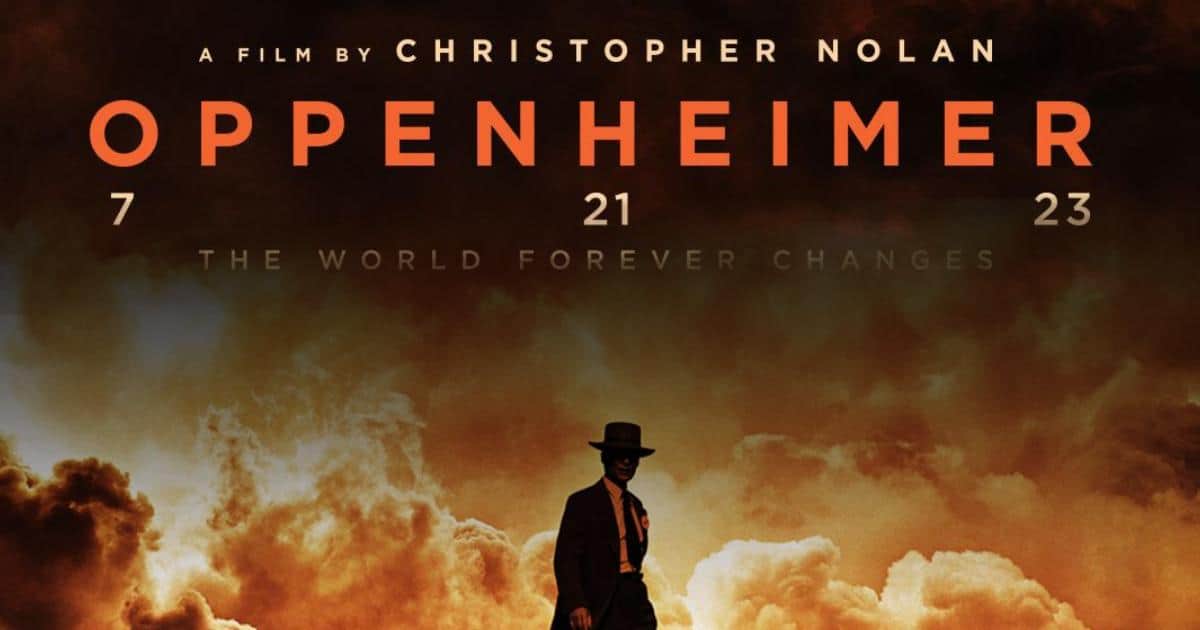
Walking out of the cinema last night, I felt as if someone had got inside my head and heart with a hand blender and turned it up to 11.
I’d been grabbed from the inside and then had my emotions ripped back, layer by layer from the opening sequence, building all the way through to the gripping, unexpected – for those unfamiliar with Oppenheimer’s life – conclusion.
If cinema is defined as an “experience” then this film certainly hits the mark with visceral precision.
At 3 hours you would think it a long watch, and, at times it is an extremely painful watch, but that’s because of the story being told, not because Christopher Nolan has mis- cut his film.
If you’re expecting a lot of science then you might be vaguely disappointed with the throw away reference to Heisenberg’s uncertainty principle and a short mention of wave/particle duality. Also the stereotypical depiction of a scientist rushing to the blackboard and writing copious equations when an erm, “interesting” possible consequence of atomic fission is theorised – is a little predictable.
These are minor points however, as I suspect most of the audience were not there for the science.
It’s the powerful drama that really makes this film and the cast convey this superbly.
I really bought into the relationships on screen, and felt some of the anguish depicted by Cillian Murphy (Oppenheimer), Emily Blunt (Kitty Oppenheimer) and Florence Pugh (Jean Tatlock) and the complicated relationship between them. This, coupled with the visual and audio effects – and those effects are delivered to you with the subtlety of a freight train – make for a hugely engaging and absorbing cinematic experience.
The film illustrates the dichotomy that Oppenheimer feels, on the one hand the ‘gadget’ – as they refer to it throughout, as scientists don’t build weapons – saved countless American (and Japanese) soldiers, sailors and airmen. But many, many innocent Japanese civilians were killed or severely injured by the use of an atomic weapon, not once, but twice on Japanese cities – namely Hiroshima and Nagasaki.
Although the decision to use the bomb on Japan is seen as a personal weight on Oppenheimer’s mind as Germany had already surrendered – and didn’t even have an atomic bomb (sound familiar?), the film, for the most part steers clear of the political decision to use the weapon.
It is a compelling, difficult watch but a must-see all the same, illustrating the effect on humanity, of building the atomic bomb, seen through the eyes of the human who oversaw its creation and in turn the effect on him.
The film cut me in half as I’m sure Oppenheimer felt, and if this film leaves you feeling conflicted, confused and emotional then I think it has achieved what I believe was Nolan’s aim:
namely, outstanding cinema, telling a difficult and divisive story from a perspective that perhaps few have considered.
Oppenheimer’s.
I could have come at this review from many angles as the film encompasses adultery, America’s obsession with communism, pop culture and the power and danger that come with it, and many more besides. I could have written 2000-3000 words, but then you’d have got bored and stopped reading so I chose the story that hit me the hardest, the human one.
This story, after all, is a human story – his story: his journey from undergraduate to celebrity physicist and all the tragedy and difficulty that involved before, during and after the creation of the atomic bomb.
Oppenheimer gave humanity the power to destroy itself. Will we ever use that power?
I think that is what he was afraid of.
 Dan Roach Flying Author
A very personal take on the film Dan.
This is another genius intent by Nolan I think .
The audience is a whole but the emotional wake of the film is individual.
You did very well to write this review and not spoil the experience or watching the film .
LikeLiked by 1 person
Thanks Caroline. I wanted to get across how I felt so I’m glad you liked it. It was you that inspired me to have a go at a film review the other day!
LikeLike
You are very welcome Dan. 🙂
LikeLiked by 1 person