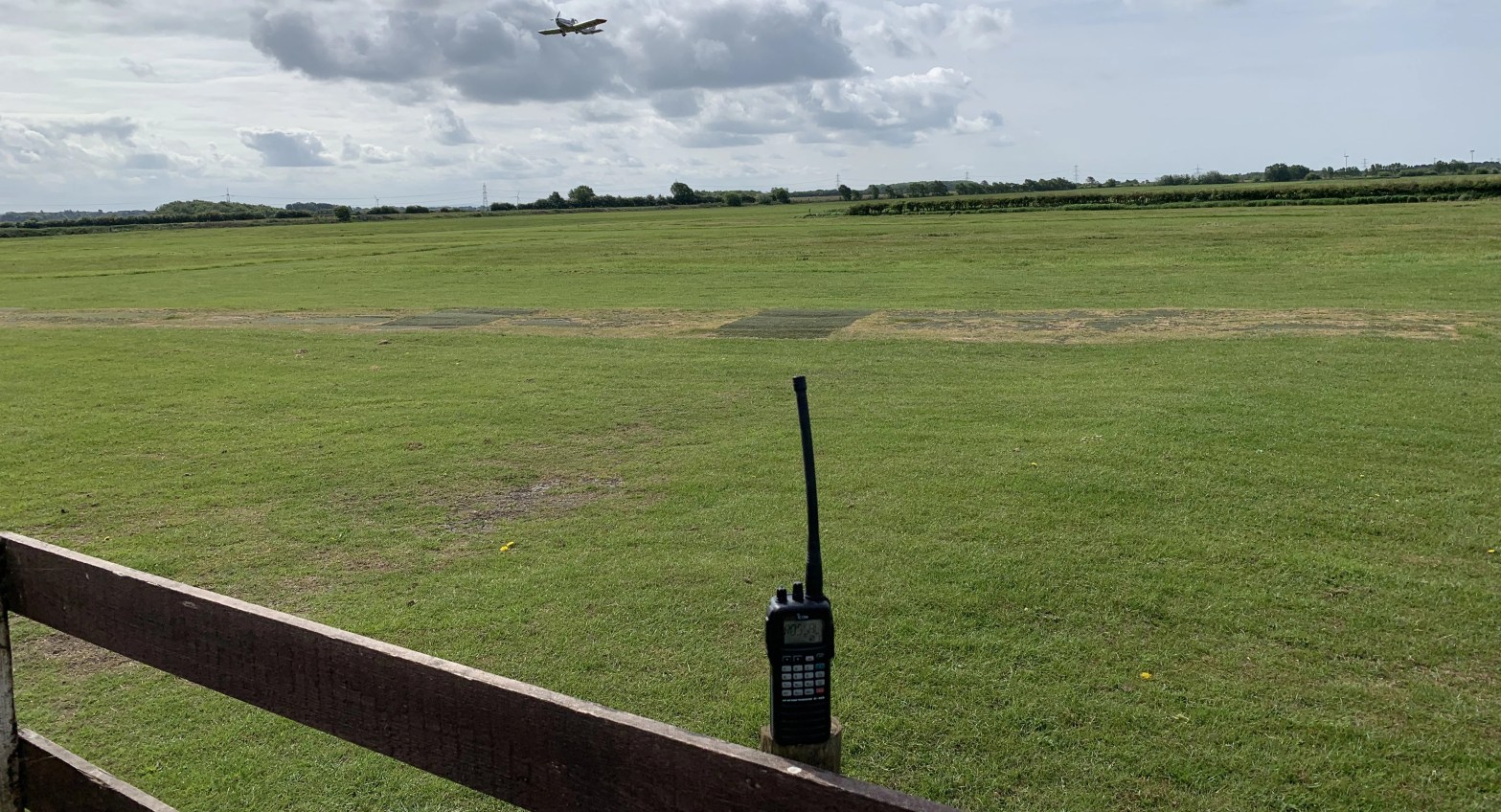
“Final to land zero two,” announces the anonymous voice on the radio in the club house
I glance up at final approach, and naturally there is no aircraft there.
Shifting my gaze slightly more eastwards, I eventually find the aircraft from which the radio call emanated half way along right base.
“You’re not though. Are you?” I mutter to myself, imagine the eye rolling emoji…
“Golf Alpha Bravo Charlie Delta overhead descending for downwind join…”
What does that even mean?
Again, a glance to the overhead shows no sign of the aircraft from which this fabulously cryptic radio call was transmitted.
You might think I’m being pedantic but the above two examples are just two of many that I regularly hear when I fly.
“But why does it matter?” I hear you ask.
Safety.
It’s really as simple as that. If you’re going to use the radio, and of course, no one has to *, then be accurate in your position reporting and intentions. No one is saying your R/T procedures must be faultless, indeed I recently invented ‘Late Final two zero’ as a radio call when under a little pressure, instead of the more traditional ‘Short Final two zero’, however it still conveyed exactly where I was and what the situation was.
The BMAA Circuit Matters document states:
“13.11. The “final” call is made when the aircraft has turned from the base leg to the final approach leg.“
Calling final when you are not is simply dangerous and gives people a false indication of where the traffic is. Similarly, calling downwind, when you are at the end of the crosswind leg and just starting to turn is just as risky.
From BMAA Circuit Matters document again:
“13.7. The “downwind” call is made when the aircraft is abeam the upwind end of the runway flying in the downwind leg.”
In plain English that’s when you are directly across from the end of the runway from which you intend to land. If you take a look at the image below you will see the problem quite clearly if the downwind call is made at the end of the crosswind leg.
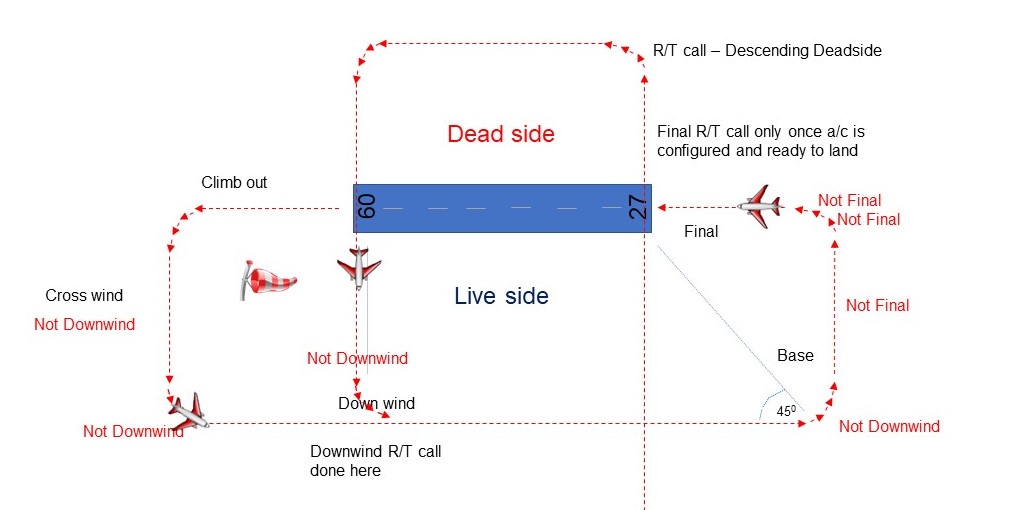
Imagine the pilot who has joined overhead using a standard overhead join and is now flying the abbreviated crosswind leg to join mid way downwind. If that pilot hears you call downwind, they will likely assume you will not be a threat to them, and will be further ahead on the downwind leg, when the reality would be far different as the aircraft converge on the same bit of air.
So yes, it matters.
Of course everyone should be keeping a good lookout and not just relying on the radio, but in reality, we are all humans and those inaccurate position calls have and will cause accidents, of that, I have no doubt.
Another point to make, and I’m sure we all remember our own instructors drumming this in to us, is fly the damn aircraft, and then, if there is time and it’s safe to do so, make a radio call.
Don’t worry if you can’t make the downwind radio call; do your downwind checks first.
Don’t worry if you can’t make the final radio call; configure the aircraft to land first.
What you shouldn’t do is try and cram your radio call in first by making it early; this is the kind of thing that may lead to bad habits and poor position reporting.
So, the message of this post is simple: think before you transmit. Be accurate in your location/position reporting. And if you get it wrong, just make a correction call.
I’ll leave you with this, small anecdote.
I recently heard a story of a pilot who when working as a ground call sign giving radio checks at a recent fly in, kept giving “readability 4”. When challenged by a colleague on this, who said “but they are perfectly readable,” the response was “Ahh, but I never give a five as I’ve got bad hearing.”
Straight from CAP413 I’m sure you’ll agree, and absolutely terrifying…
Fly safe, and if in doubt or unsure on the radio, ask an instructor or a FISO/ATCO for advice. We’ll all be delighted to help.
* in uncontrolled airspace, unless it is a Radio Mandatory Zone (RMZ)
 Dan Roach Flying Author