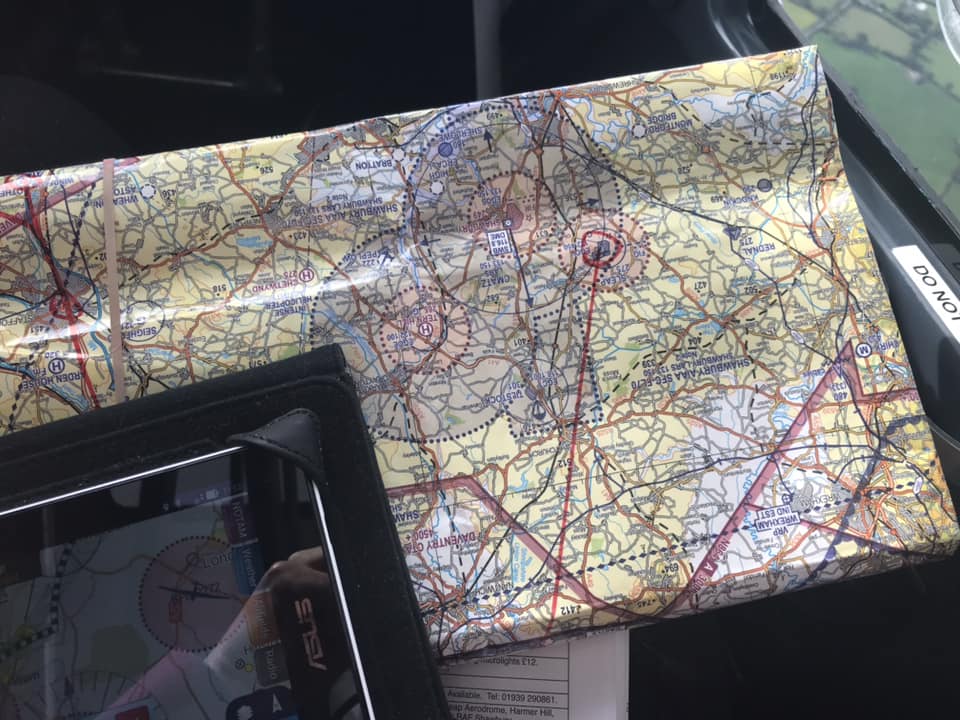
My plans for a two ship with Rory the previous day hadn’t worked out due to the usual famed glorious North Western weather that morning. So, having taken it easy at his ‘welcome to the winter’ party the previous evening, Kaz and I arrived at Barton bright an early ready for a trip to Sleap for breakfast.
Kaz was very excited as this was the first flight that we had taken together in a C42 since she had started her NPPL training in the same aircraft and so she wanted to join in with the walk around and then share the navigation duties during the flight.
More on that later.
We were slightly late departing, however a cursory glance at SkyDemon assured me of reasonable flight times down the low-level corridor (LLC) to Sleap; and the weather was stunning. A gorgeous late summers morning that was perfect for getting sky time. Departing on runway 26L we immediately headed straight out of the circuit to the west, levelling off at around 1000ft AMSL as I didn’t see the point in climbing unnecessarily to only descend again in a couple of minutes time.
“Golf-Delta Alpha departing the circuit to the West and changing to Manchester Radar on one one eight decimal five seven.”
“Golf-Delta Alpha, squawk 7000, see you later”
And with the radio pleasantries complete we were on our way.
Although I had SkyDemon programmed, Kaz took the opportunity to practice her navigation skills using the quarter mil paper map and visual reference points (VRPs) to follow our initial southerly progress. As we tracked down the LLC a glance at the indicated ground speed confirmed that we had a more substantial headwind than I had realised and so I throttled up a little to compensate.
Glancing across the cabin, I smiled at Kaz who was enjoying herself identifying the VRPs whilst I was keeping a good lookout for other aircraft.
It crossed my mind at this point that following the recent CAA ‘take 2’ initiative could be quite problematic in this particular bit of airspace. Take 2 advises that pilots remain at least 2 miles from controlled airspace horizontally and a minimum of 200 feet vertically.
Great advice normally but within the LLC that could more difficult to achieve. Let me talk you through it.
The LLC is only 4 miles wide and has a vertical altitude limit of 1300ft. Now let’s add in the air navigation order’s (ANO) rule 5 (2) (c) which states that aircraft shall not fly below 1000ft in congested areas. I’m sure you can see the potential for ‘conflict’.
If all the pilots using the LLC keep to the ‘take 2’ guidance and follow the air navigation order (ANO) then all traffic will be flying dead centre of the LLC with 2 miles on either side of empty airspace. To compound this the same aircraft will be ensuring they remain above 1000 feet and below 1100ft to allow 200ft vertical separation.
Allow me to illustrate this.

So, it would appear it is a narrow portion of airspace 100ft deep.
However, thankfully, this is not the case as the LLC airspace is notified for the purposes of Rule 5 (2) (c) which basically means the 1000ft rule does not apply. I’m not sure if all pilots are aware of this though, given where quite a lot choose to fly in the LLC i.e. dead centre at around 1000 to 1100 feet.
It’s not the most comforting thought, and not really my idea of fun playing ‘dodge the oncoming aircraft’, so I always fly a little off the centre and skirt the built-up areas which allows me to fly a little lower while still remaining safe and legal. This still gives me a safe vertical separation from Manchester’s controlled airspace whilst hopefully improving my chances of not disputing the same bit of airspace as anyone else. Happily, on this occasion we were all ok, right up until the point that we exited the LLC just to the west of Ashcroft airfield.
At this point I’d started to initiate our climb and a gentle right turn to put us onto our final south westerly heading for Sleap when Kaz frantically announced “plane plane.”
That got my attention.
“Where?” I replied as I continued my scan looking to see what I had missed.
Continuing the degeneration of the situation into some kind of latter-day Benny Hill sketch she says “there there.”
#useful
I could almost hear the music. Dede de, duh duh dede duh duh duh dede duh duhhh dede dede de de…
Fortunately, we did manage to communicate effectively eventually so that I understood there was an aircraft underneath crossing right to left on a similar south westerly heading to us. “Probably also bound for Sleap” I thought. After a few tense moments I saw a Piper PA28 emerge under my port wing, at least 500ft beneath us.
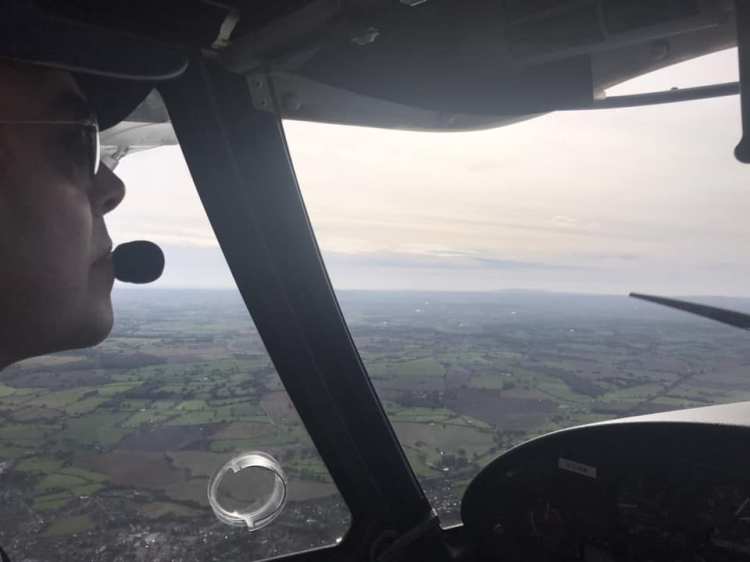
“No conflict” and I relaxed a little and commenced my seemingly pointless calls to Shawbury Radar. Pointless because RAF stations don’t work at the weekend generally. It is always best to call though, just in case you missed a NOTAM and there is an air show (admittedly that’s not likely in October) or perhaps some other out-of-the-ordinary exercise being conducted at the defence helicopter training school that was made famous for training a certain couple of princes to fly Chinooks and Apaches.
After the intensity of concentrating in the LLC and then our close encounter-of-a-slightly-stressful-kind I was glad when the rest of the outbound leg passed uneventfully and we joined the circuit overhead behind the PA28 that had overtaken us at Ashcroft. I performed a good well held off landing on runway 23 and turned to taxy to the parking area. Kaz also noted it was her first landing on a tarmac runway and she had really enjoyed the feeling of landing on a hard runway just like the big planes.
We deplaned (I think that’s a verb) to the café skipping past a load of bikers in the queue to order a quick cup of tea. Fortunately, Sleap have a very understanding system where they prioritise pilots for service at peak times, presumably because they know that many pilots have booked a shared or school aircraft and need to be back by a specific time.
As we were deciding whether to participate in the queue or not, two guys behind us asked us what we were doing. It turned out they were the pilots from the “plane, plane”, on a flight out from Blackpool, and also on a schedule. We chatted for a few seconds and I explained there was no need to stand in the long queue and that I was going to the front in order to get something warm before returning to Barton. After considering this for approximately 13 milliseconds, they said “we’re following you.”
After getting our cups of tea (and thanking the staff profusely for serving us first), we headed to a nearby table to drink our nice warm refreshment along with the Liverpool crew who explained that thankfully, they had been visual with us the whole time during our first rendezvous earlier that day.
Suitably refreshed we re-boarded Delta Alpha after the walkaround to check the aircraft still looked, well, aircraft shaped. Fortunately, everything looked ok – the wings were level and everything looked square so I jumped in and we got strapped in.
With the usual shout of “clear prop” we started up and taxied to the threshold of runway 23 and took off. Departing swiftly, I was keen to get to the cruise as soon as possible in order to make up some time. I also set cruise power slightly higher than normal which with the generous tailwind gave us a satisfying ground speed of over 100 knots (115mph) at one point.
With the help of that tailwind and a downwind join into the circuit it looked very much like I was going to get the aircraft back bang on time which is good as I don’t like to be late. We lined up and I called final, noting the wind from the south and turned nicely to capture the centreline of the runway.

Crabbing in to keep us aligned I kicked off the crab with opposite rudder just before touchdown and applied a little into wind aileron to stop the drift, all ok so far.
As we touched down though the aircraft veered strongly to the left (into wind) and felt, well, very odd. I immediately countered and used right aileron to level the wings and stop the turn but had no idea what was happening. However, as we taxied off the runway it became apparent to me that we had either had a puncture or there was something wrong with the undercarriage so I stopped and told ATC I wanted to check it. I had a look, yep a puncture. I advised I was shutting down whilst I waited for the cavalry to arrive.
So, another incident to learn from but I’m not sure there was anything wrong with my landing. I held it off well so suspect maybe it was a slow puncture, or else we encountered some debris at Sleap on take-off? Its one I’ll keep in my mind anyway…
Kaz videoed it which has helped my assessment and I may post it to my Facebook page if anyone fancies being an armchair air crash investigator?
 Dan Roach Flying Author
Thanks great blog
LikeLiked by 1 person
Thank you I’m glad you enjoyed it!
LikeLike