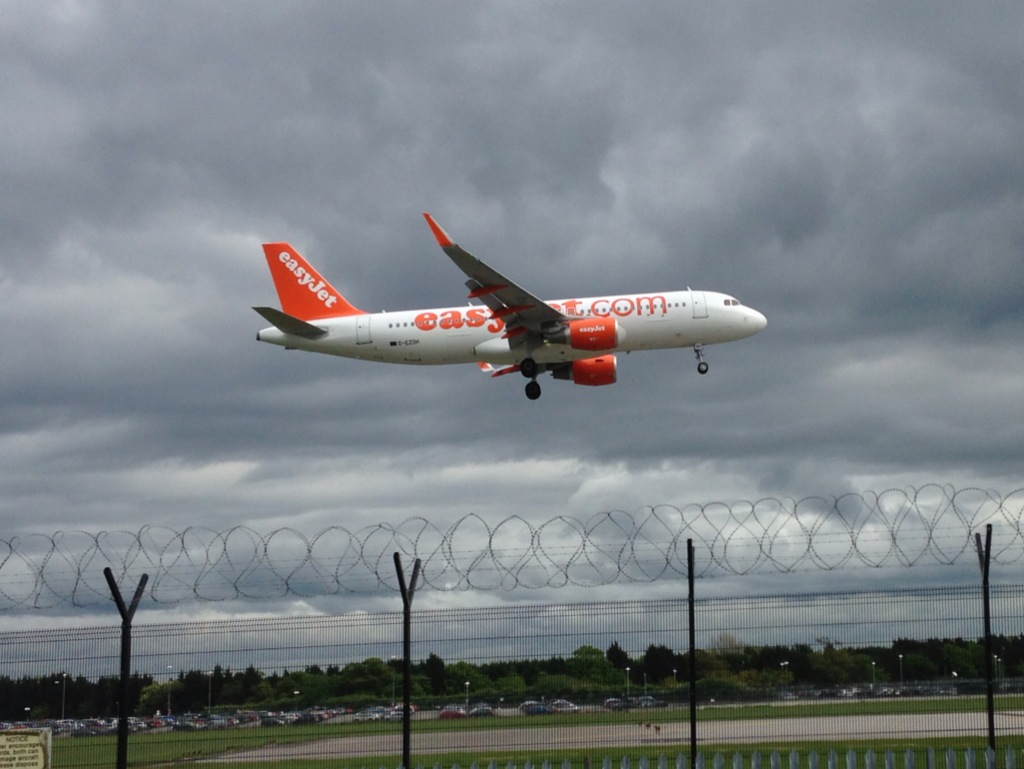
“Nerve-wracking moment plane MISSES the runway and is forced to try a second landing after getting caught in a crosswind” proclaims a Mail Online article.
As if that wasn’t enough, the article then goes on to state:
“Pilot is forced to ‘take off’ again after hovering over the runway without landing”
Wow? How did he do that? Hover an A321? Those aircraft weigh nearly 50 tons empty, let alone with passengers and fuel. That pilot must have been almost God like. I mean, I’ve hovered a Eurostar when there has been enough of a headwind at 3000 feet. In fact I know people who have flown one backwards before, but that is an aircraft that has a stall speed of 36 MPH, so you only need a 37 MPH headwind to fly backwards. That kind of wind is quite common at 3000 feet
What kind of a ground level headwind was the pilot of this aircraft flying into? It must’ve been at least 165 MPH for the aircraft to be able to ‘hover’.
I suspect, however, that it was not actually hovering and that the wind speed was somewhat less than 165 MPH. Clues to this include:
A – The aircraft was actually flying
B – The buildings in the back ground still have their roofs attached and the trees are rooted in the ground
C – It would’ve been on the news as the worst storm in UK history given that the highest ground level wind speed ever recorded in the UK is 142 MPH in Fraserburgh in 1989
Alternatively, it could have just been a blustery cross wind approach that the pilot decided wasn’t stable enough and aborted, by executing a go-around. A perfectly normal procedure that happens everywhere, every day. But hey, lets not worry about scaring infrequent flyers or people who have a fear of flying. Lets sell a few more newspapers, and get a few more hits for our website by distorting the facts. Idiots.
The go-around is a standard procedure that is carried out by pilots all the time. It is so common that each international airport usually has a published ‘go-around procedure’, e.g. the direction, altitude and speed that a pilot should fly if they decide to reject their approach and complete a circuit before attempting another landing.
Even Wikipedia has this to say
“A go-around does not in itself constitute any sort of emergency (although it could be in response to an emergency). A properly executed go-around is a routine, safe, and well-practiced manoeuvre.”
Now I appreciate that for non-frequent flyers, or people who have a fear of flying this must be terrifying, but part of that fear is related to the unexpected happening. In this case, you were expecting the aircraft to continue descending to the ground until you feel the reassuring thud of the main wheels on the runway. Instead what you get is the whine of the two jet turbines hanging underneath each wing spooling up to produce what is called TOGA thrust, or ‘Take Off/Go Around Thrust’.
Note, again, it’s not simply called Take Off Thrust. The Go-Around is so common that it is even part of the acronym used to denote a particular power setting in the aircraft.
It’s normal, it’s safe, it’s planned, it’s a procedure that pilots train for and practice. There are many reasons that a pilot may elect to go-around. Including:
1 – The approach is unstable, the pilot is not happy with the approach and thinks it is wise to throttle up and go-around for another attempt
2 – The runway is obstructed, less likely at an international airport as the controllers are on top of everything, but it does still happen sometimes
3 – Any other reason that the pilot wishes if she or he feels that this particular approach is compromised
4 – The pilot is instructed to go-around by Air Traffic Control.
In this video it appears the the aircraft gets a large gust of wind from the side that destabilises the aircraft’s approach just before touchdown. The pilot quite correctly applies TOGA and executes a go-around.
Further down in the article it shows a picture of the pilot landing at the second attempt with the comment
“the plane’s second landing does not look perfectly smooth as the plane’s wheels land alternately on the runway”
Yep that’s right folks! The pilot executed a perfectly normal crosswind landing! I guess it doesn’t sound as dramatic though if you put it like that.
There are two types of crosswind landing; the crab, or the wing down method.
With either method just prior to touch down the aircraft will be flown slightly out-of-balance, or put simply the ailerons will be used to try and turn the aircraft into wind and opposite rudder to keep the aircraft tracking straight down the centre line of the runway. This inevitably means that the into wind wheels (in this case the ones on the left of the video) may touch down first.
Perfectly normal crosswind landing procedure.
I suppose some of you are now thinking, but what if he can’t land? What if the winds are too strong across the runway for the aircraft to land?
Well, guess what? That’s covered by procedures too. Some airfields have runways that are aligned in different directions, but if that is not the case (most major airports in the UK only have main runways that run in parallel) the pilot will divert to another more suitable airfield.
So how could we improve the experience for people who are uncomfortable with flying?
Well I guess irresponsibly written articles that sensationalise and dramatise the go-around, don’t help do they? But I suppose they do sell web-advertising, and newspapers.
When I am flying with a passenger I always brief them before landing, and explain that if I am not happy with the approach then we may go-around, I also explain what that might feel like and if do go-around I talk them through it as I am executing it. Now this isn’t practical for the pilot’s of a large jet aircraft to do I realise, but perhaps it would be possible to put it in a little safety on board information card? Or maybe put it in the safety brief at the start of the flight or the announcement in flight if the destination airports winds are looking sporty?
You know? “Hey folks if the pilot chooses to, he may go-around, but don’t worry about it, all this will mean is…..” etc.
Another option for individuals is to complete a fear of flying course. Most major airports have companies that offer these, and they are done on a simulator, typically over a few hours. Most people are not scared if they know what is happening. These courses give people that information.
The problem with human beings is, in the absence of information, the imagination takes over, and the imagination is a little devil when it comes to making you fear the worst. Couple that with Newspaper editors that are not interested in an objective story designed to inform the public, but what is in my opinion an over sensationalised piece with the only aim being to increase circulation/sell more advertising?
No wonder people who already have a dread of going into the air are fearful, but there really is no need. Remember, the guys and gals at the pointy end of the aircraft? They are humans too. They most likely have families and friends that they enjoy being with. They want to go home at the end of their shift to moan about the weather or the traffic on the M62 (sorry couldn’t help but get that on in). If for a second, either of the pilot’s think that the approach is not good enough they both have the power to call the go-around, and they will do that without a seconds hesitation.
Pilots don’t want to die any more than you do. Trust me, I’m a pilot.
Copyright © 2016 Dan Roach
 Dan Roach Flying Author
Lol. Surely there are better ways to die! The reporting probably need some more proofeading!
LikeLiked by 1 person
I’ve noticed a couple of mistakes in my post, only the odd missing word. I will correct it later on.
LikeLiked by 1 person
Ah no worries, it happens to us all the time!! lol
LikeLiked by 1 person
Great post Dan. I think the best takeaway for those fearful flyers is that we all want to get home safely, and will make the best decisions possible to make that happen. And if we have to go around… that’s what we will do. My first go-around was in a 747-400 on my initial line check. ATC gave a takeoff clearance to another aircraft while we were on short final and had a 10 knot tailwind. It worked just like we are all trained.
LikeLiked by 1 person